
Raewynn Skynner: Hoch’s Yoghurt on a school trip
When Raewynn was seven or eight, her class at Matipo Primary School walked from the school on Matipo Road to the Hoch’s farm on Te Atatū Road. Mr Hoch kept his own herd of cows, and in the barn stood stainless steel vats of yoghurt. After talking about the farm and the way he made yoghurt he handed Raewynn and her classmates a small plastic cup with a wooden spoon and a scoop of yoghurt - still cold from the vat. Then he called out for his wife, and she came down the stairs from the house holding a big glass jug in both hands, containing warm fruit toppings she'd boiled up herself, which she then poured over the cold yoghurt.
She still remembers the taste.
Raewynn’s mother had one rule: home before dark. Beyond that, the children moved freely through the local neighbourhood - into other people's backyards, picking and eating whatever fruit was growing there, trusted to help themselves and trusted to come home when it was time. It was, Raewynn says, "quite a community."
Mr Hoch's yoghurt wasn't only for the children who visited the farm. It was a family business - Hoch's Yoghurt. It was a local brand sold in the local shops; Raewynn's mother bought it there too. Food didn't travel far to reach you, and you generally knew whose hands it had passed through on the way.
That connection to place ran through the food itself. Raewynn was born in 1962 and grew up in a Neil house in Te Atatū North, purchased by her parents, one of three sisters with a much younger brother. Her parents divorced when she was nine, and her mother raised four children largely on her own. Through summer, the family took the bus or went with another family in a car out to the orchards around Henderson and Oratia, coming home with crates of fruit - peaches, pears, apples - bought straight from the growers to preserve, so a summer's fruit could last the family through the rest of the year. At home, on their near quarter-acre section, they grew what they could themselves - cabbages, cauliflower, beans, peas, beetroot, parsnip, sometimes sweetcorn as an occasional treat, lettuces, tomatoes and a mound of potatoes always coming on. There were also two varieties of apples – granny smith and gala, two varieties of plum trees, a peach tree and a lemon tree.
In that household, nothing was thrown away because nothing was seen as waste to begin with - everything had a use. Potato, parsnip and carrot peelings, were put in the chest freezer and, on weekends, put into a pot to simmer down into stock for the week's soups and stews. Leftover pumpkin mash had a second life as the soup thickener. Cheaper cuts of meat were used entirely - nothing on the animal went spare. Even the butcher's paper had a second life once the meat was out of it, kept to help start the fire.
Food itself was cheaper then, in ways Raewynn still remembers precisely: milk delivered to the door at four cents a pint, lamb's tongues from the local butcher at two or three cents each. But the thrift wasn't really about the price. It was a whole way of relating to what you had - knowing where it came from, understanding what every part of it was for, and rarely, if ever, needing to buy your way around a gap.
The neighbourhood ran on small, single-purpose shops in those years - a butcher, a dairy, a baker, each on the same corner. Nothing arrived from far away, and nothing was anonymous; it came from someone whose name you knew, whose farm or shop you could walk to. That changed fast in the early 1970s, when the first Foodtown supermarkets opened nearby and the standalone shops began to close, one by one.
Asked what she makes of how we eat now, Raewynn doesn't hesitate: "It's a wasteful society." She means the plastic - fruit and vegetables sealed in it, packaging for everything - set against a childhood where butcher's paper became kindling and pumpkin became your thickener and nothing on the plate went spare. It isn't nostalgia so much as an accounting: something was lost in the trade.
Raewynn's working life eventually circled back to this same ground. She's now a Senior Librarian - Research with Auckland Libraries, which sees her recording and documenting the orchards and vineyards that once lined roads like this one across West Auckland, much of it now built over with housing. The Hoch family's own farm took a different path: once leased land from the Auckland Harbour Board, it's now Orangihina /Harbourview Reserve, kept as public green space. It's the same instinct, fifty-odd years on: paying attention to where food actually comes from, and keeping that knowledge on the record for whoever comes looking next.
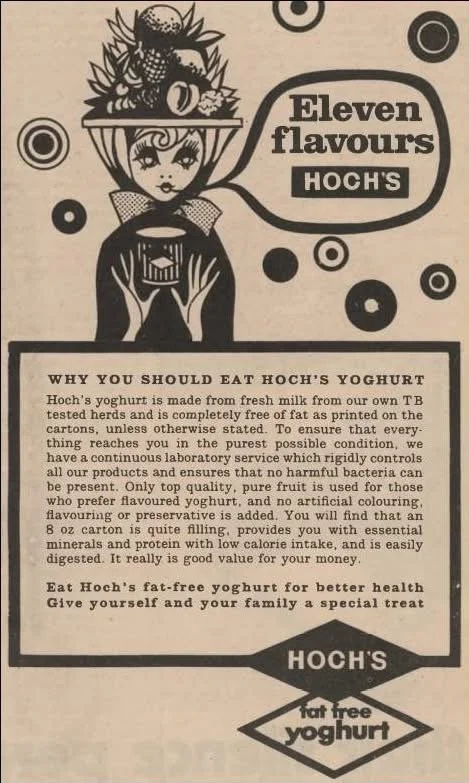
Mr Frantisek Hoch had his yoghurt factory on 465 Te Atatū Road
Mr Hoch's yoghurt wasn't only for the children who visited the farm. It was a family business - Hoch's Yoghurt. It was a local brand sold in the local shops; Raewynn's mother bought it there too. Food didn't travel far to reach you, and you generally knew whose hands it had passed through on the way.